Dear Friends and Family,
I realize that I have been out of contact with you for some time. I do not believe that I
wrote about the very conclusion of my Vietnam trip. During the two days in which I collected
my belongings in Singapore, and the two months that I was working, I had limited time, and
neglected to write, in favor of other recreational activivies. Access to this google blog has
also been restricted during my travels in China. Here are the essentials of what I have been doing.
-I toured central Vietnam, and visited the old imperial city of Hue, and saw the ruined forbidden
city of the Nguyen dynasty. I am not sure how to pronounce 'Nguyen'.
-At a different site in Hye, a imperal mausoleum,
I saw one of the loveliest Asian courtwards of my travels, with roofs arranged so that I felt comforably enclosed, but still had access to the sky. There was also a courtyard with decently manicured bonsai, in an
attractive array. There was also the blue car that can be seen in the background of the famous picture of the Buddhist monk on fire. I should mention that the events of the 1970's were not a major theme of this trip, and that
I hope to better understand them in future readings.
-I then journeyed to the immaculately preserved trading town of Hoi An, purposefully left untouched by both sides in the American War. I ran into my acquaintance from Hanoi, as I rode my bicycle past the tea house where he was sitting. I had a cup of iced chicory coffee, and we had a nice conversation. The place was run by deaf people, and the silence was serenely peaceful. A crowded, chaotic, dusty, hot, humid city like Hanoi will stress you out even if you are exclusively enganged in recreational activities as I was, and that tea house was the most relaxing place that I have ever been. There was a friendly, silent confrontation however, when I tried to pay them for the coffee, which I guess they did not keep track of since I had ordered it at the same table as my friend, who had previously ordered.
-I should mention that I also visited the thousand-year-old ruins of the Champa kingdom, whose architectural features included columns directly influenced by classical Greece, and roofs influened by Polynesia.
-In the Saigon (that's the coloquial name) airport I finally had Vietnamese food that was basically the same as the food from Eden Center, the Vietnamese shopping center in Northern Virginia, where they fly the South Vietnamese flag. Talk about a lost cause.
-In Singapore I stayed in my favorite hostel. It is probably the cheapest accomodation in Singapore. Like everything in that city, it is immaculately clean, but it is a very minimal operation. It get's Western backpackers such as myself, but it also get's a whole host of other interesting people, such as an incredibly friendly Malaysian-citizen auxiliary police officer, and some slightly shady, but still great to talk to Indian businessmen. They all remembered me from when I stayed there before I went to Vietnam, which was nice, and I went on a jog with the police officer, who is training for his fitness test. He had a funny little joke; the first time I stayed there, I had the bunk next to him (on the bottom), and before he went to sleep, he would hang up a towel from the top bunk to block any light and sound, and he would say 'OK, it's closing time, I am closing up the shop!'.
-I should also mention that I randomly ran into one of my Singaporean JHU BME classmates on the subway, after getting my stuff from storage. Gabriel Chew, are you reading this?
----------------------------------
I waved goodbye to Singapore from the plane, and I could see across the Island, and the straits of Johor, to Malaysia. A foggy overcast, combined with the tropical sun gave everything a warm orange glow, but prevented me from seeing to the Eastern or Western tips of the island.
From the Kuala Lumpur airport, all you could see was oil palm plantations from horizon to horizon, but the architeture of that airport was highly impresssive, and included a long, gently gently curved arch supporting a concourse, under which planes taxied.
After going through customs in Shanghai, I was happy to see the smiling face of a someone holding a sign that said 'Jordan Mandel, Johns Hopkins University'.
That's enough for now.
Jordan
Thursday, August 7, 2014

Friday, June 6, 2014
Leaving North Vietnam
It has been a great time. I stayed a few more days in Hanoi after writing my last post, and headed out towards an old (but very touristy) French hill station called Sapa, and hmingled with the Hmong people for a little bit, and visited some pretty isolated towns, and saw some amazing landscapes.
It is probably true that all mountain ranges have a distinctive appearance; my dad could certainly identify the mountains of Hawaii from a single photograph, and I could identify the Appalachians. Similarly, the Tonkinese Alps, as Westerners call the mountains of Northern Vietnam, have a very distinctive appearance: larger than the Appalachians, but still rounded: just as covered-in-green as the Appalachians, but green with a deeper hue. The subtropical vegetation is broken by areas of (green) grass and rice-paddies, so that it is rare to see a mountain completely covered in forest, as the Appalachians are. This brokenness should not, however, be described as 'spotty'. If the different classes of green areas could be described as a checkerboard in three shades of green, there would be at most four squares per mountain. Though the vegetation of these mountains is shorter than the forests of the Appalachians, it is generally more dense. I think that the deer, with no predators left, eat all of the underbrush of the Appalachians, causing the relative sparseness of vegetation on the forest floor.
A distinctive feature of the mountains of the older islands of Hawaii is how clear it is that water has been the main force shaping them over the millions of years. The shape of the Tonkinese Alps is notably less fluvial.
The agricultural practices of this area of Vietnam are also very interesting. Along the sides of the mountains there are terraced rice paddies, just like you've seen in pictures. Cultivating these paddies looks like incredibly difficult work. Building them in the first place requires basically amounts to changing the landscape of a whole entire mountainside. When that task is complete, cultivating the rice can involve walking waist-deep in the mud, directing your ox has he plows, or does some kind of other kind of work, something I saw several times. I like the fact that, if one were to make a topographical map of these areas, the map would be 100% accurate in the places where the rice paddies are. Another amazing sight was when, travelling along a ridge, there would be a small or medium sized hill in the valley that was completely covered in rice, so that the top of the hill was a single paddy. It looked like Legos.
They grow corn in these mountains as well, and the way they plant it is also interesting. When being driven, in the Eastern US, I like to look out the window, and look down the spaces between the long rows of corn as I go by. Here, the corn was planted densely, but haphazardly, which was a bit unsettling. It was also planted on some very steep areas of the mountains, without terracing. "How do they do that?", I thought.
I stayed a night in a Hmong village. They are very kind, but also very poor. The food that they served me (I was paying them) was actually not very much (it was enough, though, and I was satisfied), and it is possible that the shortness of the Hmong is caused by their diet as well as their genes. That is just a guess though, I would not take it too seriously. The Hmong have probably learned English better than the ethnic Vietnamese, and it serves as a common language between the ethnic minorities that live in the mountains. I was even surprised when I was able to exchange greetings with with a Hmong girl who was my age... in Spanish!
As I mentioned, here are many other ethnic minorities in these mountains besides the Hmong (such as the Dzao and Thai), all of who have their own clans, identified by a color. Each ethnic group has their own language (with dialects for each clan), clothing, and customs. The Hmong have colorful clothing, and the women wear combs in their hair. The Dzao women have headdresses made of red cloth. I saw many other styles of clothing, but I regrettably did not learn what ethnicities belong to which style of clothing. Particularly striking was one ethnic group where the old women wore majestic black headdresses, but many of these people seriously did not like having their picture taken.
I bought a few Hmong handicrafts, and their weaving reminds me of that of the people of Guatemala, examples of which can be seen at my house in Arlington.
...
After doing all of that, I came back to Hanoi for a day before a one-day, two night trip to Halong Bay, from which I returned today. The highlight of this day was the water puppet theater, located across the street from the lake that I mentioned in an earlier post (the lake where I bought the plums). I would have to say that the water puppets were the most amusing thing that I have seen in my life. I use the word 'amusing' in a very literal sense, and I acknowledge that the word 'amusing' is not taken very seriously these days. We have all seen a movie or a TV show where, right before the villain is about to vanquish the hero, the villain goes into a prolonged speech about how 'amusing' the efforts of the hero efforts of the hero and his friends are, which in turn, gives the hero a chance to make a miraculous escape, and ultimately prevail. In contrast, the water puppets were actually entertaining, and caused me to grin and lightly chuckle throughout the show.
The theater was a about two thirds of the size of a typical American movie theater, and the stage consisted of a shallow pool of water, about the width of the singles court in tennis, and about third as long. On the side of the stage opposite the audience there was a screen with it's bottom edge barely submerged in water, behind which stood the puppeteers. They operated the puppets using long poles which extended towards the audience from below the screen, so the that the puppets would move and dance on the surface of the water. These poles must have been rigged with wires that controlled the finer movements of the puppets. This form of puppetry extends back in history for about 1000 years, and was originally performed on the rice paddies surrounding Hanoi.
To the left of the stage, from the audience's perspective, was a platform upon which sat an ensemble of musicians who played traditional Vietnamese music which included an introductory piece, and accompaniment for each act of the puppet show.
The ensemble was dressed in traditional Vietnamese clothing, and was led by two female singers who also played small percussion instruments, and included a flautist (who played a traditional wooden flute: http://en.wikipedia.org/wiki/S%C3%A1o), a traditional Vietnamese zither or dulcimer, a violin-like instrument that consists of a single string, and a sound box at the base (perhaps one of these http://en.wikipedia.org/wiki/Traditional_Vietnamese_musical_instruments#Bowed), and a drummer/percussionist who had a drumset consiting of many traditional Vietnamese drums and percussion instruments. Perhaps there was a banjo-like instrument as well. In any case, all of the instruments are certainly contained on the main traditional Vietnamese instruments Wikipedia page: http://en.wikipedia.org/wiki/Traditional_Vietnamese_musical_instruments#Bowed.
The music, especially the flute, part, was rhythmically complex, and all of the musicians were well-trained. I would not be surprised if the music was based on a scale similar to the Western pentatonic scale (with added semi-tones). The singing had the particular harsh twangy harshness that can be found in east-Asian music (like Chinese opera), but it is a harshness which I actually tend to enjoy.
The show was divided into fifteen separate, unrelated acts. The program said that hundreds of traditional water puppet acts exist.
********************
Spoilers contained below.
********************
The one called 'Buffalo Boy Playing the Flute' was my favorite. It just consisted of a boy... on a buffalo... playing the flute... but the way that they made the buffalo bounce in and out of the water, and turn it's head was incredibly realistic.
Another good one was called 'Catching Fish', in which two fishermen frustratedly tried to catch fish which jumped in and out of the water. They got angry at each other, and started trying to catch each other, and in the end one fisherman caught the other in his trap at the exact moment that the other fisherman actually caught a fish.
In the Dance of the Phoenixes, two different colored phoenixes swam around, breathing fire from their mouth. Then they sort of went underwater for a little bit, and there was smoke caused by dry ice under the water, and when they popped up, one of them had laid an egg! It then hatched, and a little phoenix swam around with the two big phoenixes.
Also striking was the "Tale of the Returned Sword". It has to do with the legend concerning the lake across from the theater. Back in the day, when the Chinese or someone was invading, the gods gave the emperor of Vietnam a majestic sword, which allowed the Vietnamese armies to drive out the invaders. When it was over, a GREAT TORTOISE arose from the lake, and asked for the sword back. This is the reason that the lake is called (translated from the Vietnamese) the Lake of the Restored Sword. The tortoise puppet was painted golden, and had a deep, impressive voice.
No one can deny that the Vietnamese have shown incredible fortitude in the face of foreign invaders.
The final act was a dance of four sacred animals, and included a dragon, a phoenix, the tortoise mentioned earlier, and a mythical creature that is translated into English as unicorn, but was probably one of these: http://en.wikipedia.org/wiki/Qilin.
******************
End spoilers.
******************
For 60,000 Dong, or 3USD, it was good entertainment.
So, anyway, I just got back from Halong bay, and I am going to catch the night bust to Hue, another ancient capital, from which I will go to Hoi An, a place that is reportedly worth seeing, after which I will fly out from Da Nang. This will take place in the space in about four or five days.
It is probably true that all mountain ranges have a distinctive appearance; my dad could certainly identify the mountains of Hawaii from a single photograph, and I could identify the Appalachians. Similarly, the Tonkinese Alps, as Westerners call the mountains of Northern Vietnam, have a very distinctive appearance: larger than the Appalachians, but still rounded: just as covered-in-green as the Appalachians, but green with a deeper hue. The subtropical vegetation is broken by areas of (green) grass and rice-paddies, so that it is rare to see a mountain completely covered in forest, as the Appalachians are. This brokenness should not, however, be described as 'spotty'. If the different classes of green areas could be described as a checkerboard in three shades of green, there would be at most four squares per mountain. Though the vegetation of these mountains is shorter than the forests of the Appalachians, it is generally more dense. I think that the deer, with no predators left, eat all of the underbrush of the Appalachians, causing the relative sparseness of vegetation on the forest floor.
A distinctive feature of the mountains of the older islands of Hawaii is how clear it is that water has been the main force shaping them over the millions of years. The shape of the Tonkinese Alps is notably less fluvial.
The agricultural practices of this area of Vietnam are also very interesting. Along the sides of the mountains there are terraced rice paddies, just like you've seen in pictures. Cultivating these paddies looks like incredibly difficult work. Building them in the first place requires basically amounts to changing the landscape of a whole entire mountainside. When that task is complete, cultivating the rice can involve walking waist-deep in the mud, directing your ox has he plows, or does some kind of other kind of work, something I saw several times. I like the fact that, if one were to make a topographical map of these areas, the map would be 100% accurate in the places where the rice paddies are. Another amazing sight was when, travelling along a ridge, there would be a small or medium sized hill in the valley that was completely covered in rice, so that the top of the hill was a single paddy. It looked like Legos.
They grow corn in these mountains as well, and the way they plant it is also interesting. When being driven, in the Eastern US, I like to look out the window, and look down the spaces between the long rows of corn as I go by. Here, the corn was planted densely, but haphazardly, which was a bit unsettling. It was also planted on some very steep areas of the mountains, without terracing. "How do they do that?", I thought.
I stayed a night in a Hmong village. They are very kind, but also very poor. The food that they served me (I was paying them) was actually not very much (it was enough, though, and I was satisfied), and it is possible that the shortness of the Hmong is caused by their diet as well as their genes. That is just a guess though, I would not take it too seriously. The Hmong have probably learned English better than the ethnic Vietnamese, and it serves as a common language between the ethnic minorities that live in the mountains. I was even surprised when I was able to exchange greetings with with a Hmong girl who was my age... in Spanish!
As I mentioned, here are many other ethnic minorities in these mountains besides the Hmong (such as the Dzao and Thai), all of who have their own clans, identified by a color. Each ethnic group has their own language (with dialects for each clan), clothing, and customs. The Hmong have colorful clothing, and the women wear combs in their hair. The Dzao women have headdresses made of red cloth. I saw many other styles of clothing, but I regrettably did not learn what ethnicities belong to which style of clothing. Particularly striking was one ethnic group where the old women wore majestic black headdresses, but many of these people seriously did not like having their picture taken.
I bought a few Hmong handicrafts, and their weaving reminds me of that of the people of Guatemala, examples of which can be seen at my house in Arlington.
...
After doing all of that, I came back to Hanoi for a day before a one-day, two night trip to Halong Bay, from which I returned today. The highlight of this day was the water puppet theater, located across the street from the lake that I mentioned in an earlier post (the lake where I bought the plums). I would have to say that the water puppets were the most amusing thing that I have seen in my life. I use the word 'amusing' in a very literal sense, and I acknowledge that the word 'amusing' is not taken very seriously these days. We have all seen a movie or a TV show where, right before the villain is about to vanquish the hero, the villain goes into a prolonged speech about how 'amusing' the efforts of the hero efforts of the hero and his friends are, which in turn, gives the hero a chance to make a miraculous escape, and ultimately prevail. In contrast, the water puppets were actually entertaining, and caused me to grin and lightly chuckle throughout the show.
The theater was a about two thirds of the size of a typical American movie theater, and the stage consisted of a shallow pool of water, about the width of the singles court in tennis, and about third as long. On the side of the stage opposite the audience there was a screen with it's bottom edge barely submerged in water, behind which stood the puppeteers. They operated the puppets using long poles which extended towards the audience from below the screen, so the that the puppets would move and dance on the surface of the water. These poles must have been rigged with wires that controlled the finer movements of the puppets. This form of puppetry extends back in history for about 1000 years, and was originally performed on the rice paddies surrounding Hanoi.
To the left of the stage, from the audience's perspective, was a platform upon which sat an ensemble of musicians who played traditional Vietnamese music which included an introductory piece, and accompaniment for each act of the puppet show.
The ensemble was dressed in traditional Vietnamese clothing, and was led by two female singers who also played small percussion instruments, and included a flautist (who played a traditional wooden flute: http://en.wikipedia.org/wiki/S%C3%A1o), a traditional Vietnamese zither or dulcimer, a violin-like instrument that consists of a single string, and a sound box at the base (perhaps one of these http://en.wikipedia.org/wiki/Traditional_Vietnamese_musical_instruments#Bowed), and a drummer/percussionist who had a drumset consiting of many traditional Vietnamese drums and percussion instruments. Perhaps there was a banjo-like instrument as well. In any case, all of the instruments are certainly contained on the main traditional Vietnamese instruments Wikipedia page: http://en.wikipedia.org/wiki/Traditional_Vietnamese_musical_instruments#Bowed.
The music, especially the flute, part, was rhythmically complex, and all of the musicians were well-trained. I would not be surprised if the music was based on a scale similar to the Western pentatonic scale (with added semi-tones). The singing had the particular harsh twangy harshness that can be found in east-Asian music (like Chinese opera), but it is a harshness which I actually tend to enjoy.
The show was divided into fifteen separate, unrelated acts. The program said that hundreds of traditional water puppet acts exist.
********************
Spoilers contained below.
********************
The one called 'Buffalo Boy Playing the Flute' was my favorite. It just consisted of a boy... on a buffalo... playing the flute... but the way that they made the buffalo bounce in and out of the water, and turn it's head was incredibly realistic.
Another good one was called 'Catching Fish', in which two fishermen frustratedly tried to catch fish which jumped in and out of the water. They got angry at each other, and started trying to catch each other, and in the end one fisherman caught the other in his trap at the exact moment that the other fisherman actually caught a fish.
In the Dance of the Phoenixes, two different colored phoenixes swam around, breathing fire from their mouth. Then they sort of went underwater for a little bit, and there was smoke caused by dry ice under the water, and when they popped up, one of them had laid an egg! It then hatched, and a little phoenix swam around with the two big phoenixes.
Also striking was the "Tale of the Returned Sword". It has to do with the legend concerning the lake across from the theater. Back in the day, when the Chinese or someone was invading, the gods gave the emperor of Vietnam a majestic sword, which allowed the Vietnamese armies to drive out the invaders. When it was over, a GREAT TORTOISE arose from the lake, and asked for the sword back. This is the reason that the lake is called (translated from the Vietnamese) the Lake of the Restored Sword. The tortoise puppet was painted golden, and had a deep, impressive voice.
No one can deny that the Vietnamese have shown incredible fortitude in the face of foreign invaders.
The final act was a dance of four sacred animals, and included a dragon, a phoenix, the tortoise mentioned earlier, and a mythical creature that is translated into English as unicorn, but was probably one of these: http://en.wikipedia.org/wiki/Qilin.
******************
End spoilers.
******************
For 60,000 Dong, or 3USD, it was good entertainment.
So, anyway, I just got back from Halong bay, and I am going to catch the night bust to Hue, another ancient capital, from which I will go to Hoi An, a place that is reportedly worth seeing, after which I will fly out from Da Nang. This will take place in the space in about four or five days.
Monday, May 26, 2014
More Hanoi
This will be a concise post.
When I started writing all of the words had funny diacritics on them because the computer was in Vietnamese mode. So, anyway, when I left you last time, I had just gotten up from a nap, and I was eager to explore Hanoi some more.
So, I walked around, and ate some rice porridge from a nice old lady; it was a really small street food operation, just an old lady a pot and a single stool.
I decide I want to get a bus ticket to Halong Bay, and I have to hire a motorbike. Hanoi is one big 'no thank you' because the guys with motorbikes are always asking to give you a ride. They sit on the corner all day, just asking to give rides, I don't see how they make a living. So I hire this guy, and the traffic was crazy, my parents would have had a collective heart attack, but it was really fun. I wore a helmet. He dropped me at the wrong bus station, and I take the public bus, the 08, back. I see a large part of Hanoi with no tourists; but I hear they are not very accommodating to non-Vietnamese speakers. The lights and densely packed commerce reminded my of New York City. Hanoi has French coffee culture, and I saw a Cafe called 'Cafe Bodega'.
That night I wrote the previous Blog post.
The next day, I got coffee at an amazing Cafe that had been in business since 1936. It was tall, narrow, with steep staircases, and short stools. I rode over there on a motorbike with a seriously pretty girl from California, and we had our coffee on the third floor balcony. She has regrettably left Hanoi.
Later that day I saw the French quarter. The little public parks were just like those of Washington DC, except that the centerpieces (statues, etc) incorporated Asian elements; Imagine dragons adorning the fountain in DuPont Circle. There was a lot of French architecture, also similar to Washington, DC.
I went to a temple called the Temple of literature; the roofs were made of terra cotta scales; I can't make heads or tails of Asian roofs usually, so I was glad to see one that I understood. There were many large granite stones with Chinese inscriptions. Probably the most lovely Asian temple I have ever been to.
Went to the prison where John McCain was kept. Saw his flight suit. Pictures of American POWs having a good time, an obvious fabrication. The museum did a good job of explaining how bad it was to be a Vietnamese prisoner under the French, though.
Went to Ho Chi Minh mausoleum, but not the immaculately preserved man himself Saw guards in seriously good looking white uniforms.
Then did some sort of fun activity by the lake; I had been recruited by some people to help teach some Vietnamese kids some English; seriously fun and enthusiastic program organizers my age; I could never be that cheery and enthusiastic for so long, but I bet I could manage to somehow organize fun activities for kids; when I babysat, the kids thought I was good. Added some of the organizers on Facebook.
Yesterday, I was eating some great dumplings on the street, got into a convo with the Vietnamese girls to the right of me, she has great English, turns out she studies bioengineering at UC Berkeley, friended her on Facebook.
Vietnamese is hard; if you don't get the tones right for even things like 'Thank you' or the name of the street you live on, they won't even understand you. But I hear that the tones come with practice, and once you get them the grammar is easy, and writing is easy because they use the Western alphabet.
Photos coming eventually, my Hemingway-esque descriptions should suffice for now.
Baruch Hashem.
When I started writing all of the words had funny diacritics on them because the computer was in Vietnamese mode. So, anyway, when I left you last time, I had just gotten up from a nap, and I was eager to explore Hanoi some more.
So, I walked around, and ate some rice porridge from a nice old lady; it was a really small street food operation, just an old lady a pot and a single stool.
I decide I want to get a bus ticket to Halong Bay, and I have to hire a motorbike. Hanoi is one big 'no thank you' because the guys with motorbikes are always asking to give you a ride. They sit on the corner all day, just asking to give rides, I don't see how they make a living. So I hire this guy, and the traffic was crazy, my parents would have had a collective heart attack, but it was really fun. I wore a helmet. He dropped me at the wrong bus station, and I take the public bus, the 08, back. I see a large part of Hanoi with no tourists; but I hear they are not very accommodating to non-Vietnamese speakers. The lights and densely packed commerce reminded my of New York City. Hanoi has French coffee culture, and I saw a Cafe called 'Cafe Bodega'.
That night I wrote the previous Blog post.
The next day, I got coffee at an amazing Cafe that had been in business since 1936. It was tall, narrow, with steep staircases, and short stools. I rode over there on a motorbike with a seriously pretty girl from California, and we had our coffee on the third floor balcony. She has regrettably left Hanoi.
Later that day I saw the French quarter. The little public parks were just like those of Washington DC, except that the centerpieces (statues, etc) incorporated Asian elements; Imagine dragons adorning the fountain in DuPont Circle. There was a lot of French architecture, also similar to Washington, DC.
I went to a temple called the Temple of literature; the roofs were made of terra cotta scales; I can't make heads or tails of Asian roofs usually, so I was glad to see one that I understood. There were many large granite stones with Chinese inscriptions. Probably the most lovely Asian temple I have ever been to.
Went to the prison where John McCain was kept. Saw his flight suit. Pictures of American POWs having a good time, an obvious fabrication. The museum did a good job of explaining how bad it was to be a Vietnamese prisoner under the French, though.
Went to Ho Chi Minh mausoleum, but not the immaculately preserved man himself Saw guards in seriously good looking white uniforms.
Then did some sort of fun activity by the lake; I had been recruited by some people to help teach some Vietnamese kids some English; seriously fun and enthusiastic program organizers my age; I could never be that cheery and enthusiastic for so long, but I bet I could manage to somehow organize fun activities for kids; when I babysat, the kids thought I was good. Added some of the organizers on Facebook.
Yesterday, I was eating some great dumplings on the street, got into a convo with the Vietnamese girls to the right of me, she has great English, turns out she studies bioengineering at UC Berkeley, friended her on Facebook.
Vietnamese is hard; if you don't get the tones right for even things like 'Thank you' or the name of the street you live on, they won't even understand you. But I hear that the tones come with practice, and once you get them the grammar is easy, and writing is easy because they use the Western alphabet.
Photos coming eventually, my Hemingway-esque descriptions should suffice for now.
Baruch Hashem.
Saturday, May 24, 2014
Hanoi: Some more, Till Day 2 Morning
So, we set off in this van, and I am sitting next to the other Western traveler. Things seem pretty normal, except for that there are more motorcycles on the road than normal. Overall, I am impressed by how modern the country seems;a big paved highway, with development all around me; this was in stark contrast to Myanmar, where the grittiness and vague incompleteness of the development implied seriously lacking economic development. The other traveler was Elena, from the Netherlands; she was on a fairly large break from work, travelling, spoke with an excellent Canadian accent, and is staying at the other branch of the hostel at which I am staying, but I have not seen her since.
We arrive at a really nice tree-lined lake in the middle of Hanoi, and I walk down the side; there is a red bridge to a temple in the middle of the lake, as well as a mini-pagoda in the middle of the lake; there are benches by the side of the lake, and everyone is having a good time. I buy some grapey-looking things from an old lady, and it turns out that they are mini-plums, and she puts a mixture of sugar and chili powder on them. I contentedly walk by the lake, eating my spicy little plums, sweating, and drinking some water.
Then I have to cross the street. There is a crosswalk, but no light, and there are motorcycles and cars going in both directions, except that within the directions, there is no semblance of lanes, or anything, they are just sort of doing what they want, so I just stand there as this mass of motorbikes glides by; meanwhile Vietnamese people are just casually walking through the mass of traffic, as if it is no big deal. Eventually there is a break, and I am able to run across, but it seemed like these people had some magical 'not getting hit by motorcycles' ability.
So, I am in the old city of Hanoi, and it is a huge mass of motorcycles, pedestrians, and larger vehicles, spilling onto the sidewalks; the buildings are majestic but faded, in a style that seems colonial, even though this part of the city dates back 1000 years. There are people sitting on little plastic chairs, spilling from the sidewalk onto the streets, eating some food. Shops are also spilling onto the sidewalks from the storefronts. Everything is spilling everywhere.
With the help of my great 3G SIM card, and the surprisingly excellent google maps coverage, I make it to the hostel without incident. Overall, it is a very nice place, for $8 a night you get a nice lounge area, breakfast, and a bed in a dorm. It has clean interior, with modern-ish architecture, and almost everyone is an incredibly attractive young person, just like myself.
I had originally booked at the other hostel, but switched my booking to this branch when it had one extra half star, but Elena had said her friends liked the other one better. But I didn't switch back, because that would be way too much changing my mind, sometimes I just have to stick with my nearly inconsequential decisions! The main difference is that this hostel can be pretty rowdy, and the other one is chilled out. There is thumping music coming from be bar (yes the hostel has a bar) as I type this. I read that it might be the biggest hostel in Southeast Asia. More on that later.
So, I go to my room, and get my stuff together, putting it in the locker. I decide to get lost, and just star walking; the streets are much like what I said before, a gloriously chaotic mess; I see people eating Pho, and I sit down and have some awesome Pho Ga, which means Chicken Pho. Really good. Chickeny, spiced perfectly, with some scallions. Though the streets are narrow, they still find room for trees with purple flowers. So, I just walk down the narrow streets and labyrinthine alleys, all of which have people on plastic chairs eating street food. Though the food is close to the street, the street is only a little bit dirty, in contrast to Yangon where it really seemed like a terrible idea to eat anything that had even got within a meter of the stinky, grimy street no matter how good the food looked.
The traffic here was way worse though. In Yangon, I saw a bumper sticker with the message 'Lane Driving is Safe Driving', but they make no pretenses of following that philosophy here.
I get back to the Hostel, and decide to have a few beers with the people; people from England, Australia, and quite a few people from Galway, Ireland. None of them knew my friend Joe, though. The beer was called Larue (they had it on tap), a very light beer; the thing is though, that it actually is drinkable, unlike the beer in the super bowl advertisements. They had a thing they flipped a coin, and got an extra drink if you were right; by patting the Irish people on the shoulder before I went, I was able to make my chances of winning to .75 from .5. The Irish people were OK with it, they laughed about it too. We we got some more Pho on the street. The slices of beef in the soupe were super fatty, but in a really good way, so as to be pleasing to the palate.
We then all went out to some other Western (not Cowboy, just Western in the sense of not Asian) style bar, and had a good time. There was a computer from which the patrons could put on songs, and I chose Soul Shakedown Party by Bob Marley. Yeah, going to western style Bar is not that authentic, but I am forced to go mainstream when I interact with other people.
I had a great time, but drank just enough to give me a headache during the free walking tour the next day (which was pretty good, but not great). I had to take a nap after that headachey tour in the hot sun, which was when I had another pretty serious adventure.
We arrive at a really nice tree-lined lake in the middle of Hanoi, and I walk down the side; there is a red bridge to a temple in the middle of the lake, as well as a mini-pagoda in the middle of the lake; there are benches by the side of the lake, and everyone is having a good time. I buy some grapey-looking things from an old lady, and it turns out that they are mini-plums, and she puts a mixture of sugar and chili powder on them. I contentedly walk by the lake, eating my spicy little plums, sweating, and drinking some water.
Then I have to cross the street. There is a crosswalk, but no light, and there are motorcycles and cars going in both directions, except that within the directions, there is no semblance of lanes, or anything, they are just sort of doing what they want, so I just stand there as this mass of motorbikes glides by; meanwhile Vietnamese people are just casually walking through the mass of traffic, as if it is no big deal. Eventually there is a break, and I am able to run across, but it seemed like these people had some magical 'not getting hit by motorcycles' ability.
So, I am in the old city of Hanoi, and it is a huge mass of motorcycles, pedestrians, and larger vehicles, spilling onto the sidewalks; the buildings are majestic but faded, in a style that seems colonial, even though this part of the city dates back 1000 years. There are people sitting on little plastic chairs, spilling from the sidewalk onto the streets, eating some food. Shops are also spilling onto the sidewalks from the storefronts. Everything is spilling everywhere.
With the help of my great 3G SIM card, and the surprisingly excellent google maps coverage, I make it to the hostel without incident. Overall, it is a very nice place, for $8 a night you get a nice lounge area, breakfast, and a bed in a dorm. It has clean interior, with modern-ish architecture, and almost everyone is an incredibly attractive young person, just like myself.
I had originally booked at the other hostel, but switched my booking to this branch when it had one extra half star, but Elena had said her friends liked the other one better. But I didn't switch back, because that would be way too much changing my mind, sometimes I just have to stick with my nearly inconsequential decisions! The main difference is that this hostel can be pretty rowdy, and the other one is chilled out. There is thumping music coming from be bar (yes the hostel has a bar) as I type this. I read that it might be the biggest hostel in Southeast Asia. More on that later.
So, I go to my room, and get my stuff together, putting it in the locker. I decide to get lost, and just star walking; the streets are much like what I said before, a gloriously chaotic mess; I see people eating Pho, and I sit down and have some awesome Pho Ga, which means Chicken Pho. Really good. Chickeny, spiced perfectly, with some scallions. Though the streets are narrow, they still find room for trees with purple flowers. So, I just walk down the narrow streets and labyrinthine alleys, all of which have people on plastic chairs eating street food. Though the food is close to the street, the street is only a little bit dirty, in contrast to Yangon where it really seemed like a terrible idea to eat anything that had even got within a meter of the stinky, grimy street no matter how good the food looked.
The traffic here was way worse though. In Yangon, I saw a bumper sticker with the message 'Lane Driving is Safe Driving', but they make no pretenses of following that philosophy here.
I get back to the Hostel, and decide to have a few beers with the people; people from England, Australia, and quite a few people from Galway, Ireland. None of them knew my friend Joe, though. The beer was called Larue (they had it on tap), a very light beer; the thing is though, that it actually is drinkable, unlike the beer in the super bowl advertisements. They had a thing they flipped a coin, and got an extra drink if you were right; by patting the Irish people on the shoulder before I went, I was able to make my chances of winning to .75 from .5. The Irish people were OK with it, they laughed about it too. We we got some more Pho on the street. The slices of beef in the soupe were super fatty, but in a really good way, so as to be pleasing to the palate.
We then all went out to some other Western (not Cowboy, just Western in the sense of not Asian) style bar, and had a good time. There was a computer from which the patrons could put on songs, and I chose Soul Shakedown Party by Bob Marley. Yeah, going to western style Bar is not that authentic, but I am forced to go mainstream when I interact with other people.
I had a great time, but drank just enough to give me a headache during the free walking tour the next day (which was pretty good, but not great). I had to take a nap after that headachey tour in the hot sun, which was when I had another pretty serious adventure.
Friday, May 23, 2014
Hanoi: Prologue
I will start with yesterday. I flew out of Singapore mostly without incident, but I had an overall feeling of unpreparedness; I had booked two nights in a hostel in the old quarter of Hanoi, but other than that, I had no idea what I am doing. The plane ride itself was fine; I tried to sleep; there were three seats for two people, which was nice. It was interesting seeing Vietnam through the plane window; I remember green colors, and red roofs.
So, we land, and we walk out to a large shuttle bus that takes us to the terminal. I come out, and I see the window where I have to apply for my Visa; I give them the approval letter, my passport, and the required form, and I give them $45 five minutes later, and my passport has a stamped visa.
I then go through immigration without incident, except for that the guy angrily tosses aside the receipt for the visa when I hand it to him with the passport.
I also walk through the 'nothing to declare' lane of customs without incident.
So, I get out into the arrivals area, and begin thinking of what I have to do;
I had changed money in Singapore, so I go into a bathroom stall to take some money from the plastic money pouch they gave me, and put it into my wallet. I go buy a SIM card, and I get a pretty good deal; unlimited data for a month, for about $15, but I will have to top up for more calling minutes.
There were several ways to get into the city; one was by taxi, and that costs a weterner about $15;
doing that, one has to be weary of scams. If you tell them the name of your hotel, they will take you to it, pretend to somehow find out that it is actually full, and then take you to a fake hotel of poor quality, and you realize how much of a fool you are when you wake up the next morning.
I didn't take a cab.
There are also public buses, but I neglected to take those, even though they are the cheapest option.
Instead, I took a minibus run by Vietnam airlines; for 40,000 Dong (~2 USD) they take you to the Vietnam airlines offices in Hanoi, which is only a medium walk away from my hostel. Taking that didn't go 100% smoothly, though.
I see the line of minibuses, and I get into the biggest one, which is empty, mostly. I sit there for a while, and I ask the guy (who I already knew spoke English) "so when is this thing leaving?". He says 'oh, whenever it fills up'.
"oh, so is it better to get on a smaller one?'
"yeah, sometimes".
So I just sit there waiting for a little while longer, and decide to get off, and onto a smaller one. I do that, and then the driver says 'why are you going there?' (in broken English; If I used words to mimic the way he sounded, it might come off as racist, so I am just typing in gramatically correct English even though it was broken English in reality). He continues "same as this one" (the one I was just on). I ask "oh, so when is it leaving?". He says "15 minutes". I grudgingly get back on, and I sit there in indecision, not wanting to be a pushy, grumpy western tourist, but not wanting to wait an hour on a still mostly empty minibus. Another Western tourist, a woman, gets on, and leaves her pack at the front of the bus. At this point we don't say anything. I then see one of the smaller buses leave full of passengers, so I get annoyed and decide to look for the public bus. So, I get out and look around for a while for the public bus, asking people. When I look back about seven minutes later, the minubus that I had been on had disappeared!
So, I walk down the terminal, to where the buses were, 'about a kilometer a way'. I should mention that it was over 100 degrees and humid; far worse than anything I had ever experienced in Singapore. At some point, I see another large minibus. The guy is like 'two dollars, Hanoi, want to get on?' and I think 'oh no I am not falling for this again' (somewhat irrational, because if I had been patient before, I could have been gone already) I say, 'when is it leaving?' and he says 'five minutes'. I think 'yeah right'. But then I ask someone else 'do you know where the 07 or 17 public busses are?' and he says 'no have'. So I figuratively say 'fuck it', and get on the second minibus. Then I notice that the Western tourist lady has switched minibuses, and is now on this one; I guess she got fed up with wasting too. Then I notice that the Vietnamese businessman who I had originally talked to had done the same thing. And then I realize that this was the same bus as I was on before, and that it had just driven down the terminal to pick up domestic passengers. I pay by 40K Dong, sit next to the other Western tourist, and we head off.
So, we land, and we walk out to a large shuttle bus that takes us to the terminal. I come out, and I see the window where I have to apply for my Visa; I give them the approval letter, my passport, and the required form, and I give them $45 five minutes later, and my passport has a stamped visa.
I then go through immigration without incident, except for that the guy angrily tosses aside the receipt for the visa when I hand it to him with the passport.
I also walk through the 'nothing to declare' lane of customs without incident.
So, I get out into the arrivals area, and begin thinking of what I have to do;
I had changed money in Singapore, so I go into a bathroom stall to take some money from the plastic money pouch they gave me, and put it into my wallet. I go buy a SIM card, and I get a pretty good deal; unlimited data for a month, for about $15, but I will have to top up for more calling minutes.
There were several ways to get into the city; one was by taxi, and that costs a weterner about $15;
doing that, one has to be weary of scams. If you tell them the name of your hotel, they will take you to it, pretend to somehow find out that it is actually full, and then take you to a fake hotel of poor quality, and you realize how much of a fool you are when you wake up the next morning.
I didn't take a cab.
There are also public buses, but I neglected to take those, even though they are the cheapest option.
Instead, I took a minibus run by Vietnam airlines; for 40,000 Dong (~2 USD) they take you to the Vietnam airlines offices in Hanoi, which is only a medium walk away from my hostel. Taking that didn't go 100% smoothly, though.
I see the line of minibuses, and I get into the biggest one, which is empty, mostly. I sit there for a while, and I ask the guy (who I already knew spoke English) "so when is this thing leaving?". He says 'oh, whenever it fills up'.
"oh, so is it better to get on a smaller one?'
"yeah, sometimes".
So I just sit there waiting for a little while longer, and decide to get off, and onto a smaller one. I do that, and then the driver says 'why are you going there?' (in broken English; If I used words to mimic the way he sounded, it might come off as racist, so I am just typing in gramatically correct English even though it was broken English in reality). He continues "same as this one" (the one I was just on). I ask "oh, so when is it leaving?". He says "15 minutes". I grudgingly get back on, and I sit there in indecision, not wanting to be a pushy, grumpy western tourist, but not wanting to wait an hour on a still mostly empty minibus. Another Western tourist, a woman, gets on, and leaves her pack at the front of the bus. At this point we don't say anything. I then see one of the smaller buses leave full of passengers, so I get annoyed and decide to look for the public bus. So, I get out and look around for a while for the public bus, asking people. When I look back about seven minutes later, the minubus that I had been on had disappeared!
So, I walk down the terminal, to where the buses were, 'about a kilometer a way'. I should mention that it was over 100 degrees and humid; far worse than anything I had ever experienced in Singapore. At some point, I see another large minibus. The guy is like 'two dollars, Hanoi, want to get on?' and I think 'oh no I am not falling for this again' (somewhat irrational, because if I had been patient before, I could have been gone already) I say, 'when is it leaving?' and he says 'five minutes'. I think 'yeah right'. But then I ask someone else 'do you know where the 07 or 17 public busses are?' and he says 'no have'. So I figuratively say 'fuck it', and get on the second minibus. Then I notice that the Western tourist lady has switched minibuses, and is now on this one; I guess she got fed up with wasting too. Then I notice that the Vietnamese businessman who I had originally talked to had done the same thing. And then I realize that this was the same bus as I was on before, and that it had just driven down the terminal to pick up domestic passengers. I pay by 40K Dong, sit next to the other Western tourist, and we head off.
Tuesday, May 20, 2014
Sunday, May 18, 2014
Interesting Day
The title is a bit redundant. But anyway; I have been living in a super cheap hostel (like $10 a night) for the past week, waiting for the people in Shanghai, where I will be doing scientific research this summer, to finally send me the paperwork for my Visa. The hostel is clean, but a very minimal operation. They finally did, and I applied on Thursday, I think, and I will be picking it up on Wednesday: the day before my student's pass expires. Then on Thursday, the 22nd, the day that my student's pass actually expires, I will be flying to Hanoi, for some as-of-yet unplanned adventures.
...
So, I got up at around 11, with no real plan. After taking a shower and brushing my teeth, I headed down to the little corner cafe (really a food court with 4 or so stalls) for a lunch-breakfast. For the past week I have been ordering a teh-ping (see a previous blog post for explanation) every day, so this morning they guessed what I wanted. I also had some sort of Malay fried noodles. It was a lot of carbs.
When I got back, I acted as money-changer for a nearly broke French guy who was just travelling in Indonesia. Took his Rupiya's and gave him my SGD so that he could at least afford to get around the city before his flight home (which reportedly was at 5 pm my time).
I then went ahead and visited Geylang Road, really a historical area of the city, with interesting colonial architecture...


 I got a super-sweet almond beverage. It was good.
At this point I was reminding myself of my travel philosophy; you don't really need a plan, just go where you feel like it, and you will see something interesting. A corollary to this is "If things can't be good, they can at least be interesting". I came to this MRT station with no idea what I would find, but I was still having a good time.
At this point it is dark out, and I keep wandering. It is clear that this is a neighborhood where South Asian (i.e. probably Tamil Nadu + Bangladesh, but many other places too) workers live. There are a lot of industrial warehouses and factories, and I can see that there are people still working, even though it is Sunday night.
There was definitely a little mini street economy going on, as evidenced by a small barber tent with hair flowing onto the sidewalk. The area was covered in trash, comared to the rest of Singapore.
I will admit that I felt a little bit out-of place, being the only white Guy. But I thought of the time that my family went to a restaurant in Arlington called Pupuseria Doña Azucena; the situation was similar, and no one cared. For the most part they guys just ignored me.
What I was looking for was a place where all the guys would be hanging out. I found it; the tables were covered in empty beers and dirty plates, and they were all watching some Bollywood movie. I got a plate of good Indian food, and a Tiger beer. They commented on how I was eating my food with my right hand, like an Indian.
Tomorrow, I am getting up a bit earlier, and will be going to the wetland reserve with my friend from France (not the broke guy mentioned above).
...
So, I got up at around 11, with no real plan. After taking a shower and brushing my teeth, I headed down to the little corner cafe (really a food court with 4 or so stalls) for a lunch-breakfast. For the past week I have been ordering a teh-ping (see a previous blog post for explanation) every day, so this morning they guessed what I wanted. I also had some sort of Malay fried noodles. It was a lot of carbs.
When I got back, I acted as money-changer for a nearly broke French guy who was just travelling in Indonesia. Took his Rupiya's and gave him my SGD so that he could at least afford to get around the city before his flight home (which reportedly was at 5 pm my time).
I then went ahead and visited Geylang Road, really a historical area of the city, with interesting colonial architecture...
The three proceeding images are of buildings that were probably built in the 1920s (I know this because one of them had a date on it). Take a look at this building built in th 1930's, though:
Can you see the Art-Deco influence? It is art-deco-British Colonial-Malay fusion.
An aside on Singapore architecture; a lot of the old buildings have a very narrowly-winding spiral staircase in-back, including the hostel that I am staying at. Here are some example-pictures that I took (first one in an area called Bugis, second in Geylang).
Overall Geylang road had a bunch of interesting shops selling Chinese medicine and things like that, and good-looking Chinese restaurants.
Oh. And Geylang is also the red light district. Here is a blurry image of a restaurant filled with creepy Chinese men and prostitutes;
 |
| not all of the restaurants were like this |
Anyway, having seen that side of town, I thought that I would visit a wetlands reserve, but it was getting late in the day. I needed to figure out how to get there, but I was out of pre-paid data for google maps, so I decided to take the MRT to city hall and find a 7-11 for a mobile top-up. The thing is though, that instead of just asking where the nearest 7-11 is, I started wandering around aimlessly, just hoping to run into one, so I wasted a bit of time in some uber-rich Singaporean underground (as in actual physical location) supermalls. At one point I saw an open area in an MRT station where people were roller blading and break dancing;
B y the time I found one (having asked), my cellphone was almost out of power anyway, and I realized that the wetlands reserves would be closing soon anyway, and they were kind of far away. But I just decided to take the MRT in that direction because I knew that there were some other natural attractions in that direction.
But my phone ran out of power, so I wound up at the remote Kranji MRT station, with no plans or ideas what to do. So, I took the bus, got off, and started walking around. The first thing I noticed was that the demographics were different than in the other parts of the city; it was about 85% south asian men, probably foreign workers. I went to a hawker center (food court) and got an egg Thosai, a kind of Indian pancake. I ate it using only my bare right hand, which is good manners in India. I kept on walking around. I found several Indian groceries where they were playing Indian music; it felt like India.
At this point I was reminding myself of my travel philosophy; you don't really need a plan, just go where you feel like it, and you will see something interesting. A corollary to this is "If things can't be good, they can at least be interesting". I came to this MRT station with no idea what I would find, but I was still having a good time.
At this point it is dark out, and I keep wandering. It is clear that this is a neighborhood where South Asian (i.e. probably Tamil Nadu + Bangladesh, but many other places too) workers live. There are a lot of industrial warehouses and factories, and I can see that there are people still working, even though it is Sunday night.
There was definitely a little mini street economy going on, as evidenced by a small barber tent with hair flowing onto the sidewalk. The area was covered in trash, comared to the rest of Singapore.
I will admit that I felt a little bit out-of place, being the only white Guy. But I thought of the time that my family went to a restaurant in Arlington called Pupuseria Doña Azucena; the situation was similar, and no one cared. For the most part they guys just ignored me.
What I was looking for was a place where all the guys would be hanging out. I found it; the tables were covered in empty beers and dirty plates, and they were all watching some Bollywood movie. I got a plate of good Indian food, and a Tiger beer. They commented on how I was eating my food with my right hand, like an Indian.
Tomorrow, I am getting up a bit earlier, and will be going to the wetland reserve with my friend from France (not the broke guy mentioned above).
Tuesday, April 15, 2014
Seder
I thought I'd write about the Seder that I went to last night.
I'll admit that at first, I foolishly wasn't planning on going to Seder because it was kind of expensive. But then my mom said 'why don't you just go anyway' and I said 'OK', and it wasn't a problem anyway because there was a student discount that I never saw.
I had known that Jews had been in Singapore since the mid-1800s, and I knew that there were two synagogues in Singapore, that use to hold a fairly large (about 4000) Jewish community, mostly Iraqi Jews. I wasn't sure, though, whether the Seder that I would be attending would include any of the original Singapore Jewish community, or whether it would just be a bunch of foreign transplants (I just hate those foreign transplants!).
The journey over was pretty stressful, because the internal NUS bus that was supposed to come every five minutes at that time didn't show up for half an hour, so I thought I was going to be late. I ended up having to get off of the MRT (metro) and take a cab, and I arrived at the Magen Aboth Synagogue just as evening services were getting out; as I was walking up, a hired security guard said 'do you have a reservation?'. I said 'well, I made a payment last night, but the email to which I was supposed to send my reservation info gave me a ' mailer daemon this email doesn't actually exist' message, so he just let me in.
The Synaogue itself was a beautiful structure, with stucco siding, a red-upholstered interior, with the platform in the middle that is typical of orthodox Sephardic Synagogues.
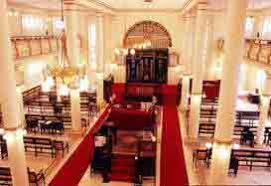

Here is a picture of the other Synagogue, Chesed El; very architecturally impressive, maybe I should take the time to visit.

When I got there, everyone was saying 'Chag Sameach' and shaking hands. One of them was a Chabadnik, around my age. I forget his name, but he asked me 'where are you from?' and I said 'The USA' and he said 'yeah, of course, but where'.
There were guys my age from quite a variety of places; mostly France, Canada, and South Africa.
Someone asked me 'which Seder are you going to?' and I said 'I'm not sure'. There was one being held in the community center right next to the Synagogue, and one being held at someones house, about a 20 minutes walk away. I was told most of the young people were going to the house, so I went there.
Often, Jews remark how amazing it is that we have a culture that spans every continent, that has been remarkably preserved for 2000 years, even between communities that have very little contact with each other. I definitely felt that on the walk over to the house.
I had some interesting conversations on the walk there, which took a good deal longer than 20 minutes.
I had some pretty ineteresting conversations on the way over there. I talked to Ari, who was studying at Richard Ivey school of business in Canada, studying abroad at Singapore Management University. He told me about his adventures in Asia, including two weeks in Japan, and many other places; he even flew to Miami for two days for a wedding. He said that the quality of the students at SMU was pretty low; that they played around on Facebook all day, and called it studying, that they were rote learners who think inside the box, and things like that. He hadn't even gone to class for two weeks, that is how much he was able to get ahead. He noted that it is usually very easy for Westerners to advance in the financial industry in Singapore; "My friend who worked for Goldman Sachs would get to work every day at six in the morning before the markets would open, and stay till ten thirty at night, but these kids show up to work at nine, take a two hour lunch break at twelve, and go home at five... this is not true, though, for the people I know from Hong Kong, those guys are seriously efficient'.
I also talked to Hillary, a girl from Sioux City, Iowa. She had done some pretty extensive travelling in SE Asia, so I told her my (very rough) travel plans for what I was going to do after my last exam, on may 7. 'I am going to start in Cambodia, travelling with some French people. I will go up through Thailand, visiting Bangkok and Chiang Mai, and to Vientiane in Laos, and take the 24 hour bus ride to Hanoi, after which I will travel south to Ho Chi Minh city, and make my way back to Singapore for my flight home, if I can do that in a month'. I am not sure how plausible that is, in the time I will have. She remarked 'Are you sure they want to go to Laos? I hear that their government is anti-American, to which I responded 'yeah I wouldn't be surprised!'. She also expressed concern about Israeli-Lao relations. But a quick Google search reveals that her fears were completely overblown.
__________________________________________________________________________________________________________________________________________________________________
So, after a very hot and humid half-hour walk, and a five-minute, twice as hot and humid elevator ride, we arrive at the apartment. It was a nice place; there was a whole entire wall covered with family photos, in a very nice geometric arrangement. The seder plates had Sephardic haroset, made from dates. At first there were not enough chairs for everyone, so but when I finally sat down, I was right next to the head of the table, with the Seder leader, and his (I think) brother in law on my left, at the head. Across from me was a very elderly lady. To her right sat a couple guys from South Africa. To my right was Thomas, a Sephardic Jew from Paris, about my age, whose family's location before Paris was Libya. So the Seder went forward pretty normally; there were two differen Haggadot, the Ashkenazi Artscroll version, and a Sephardic version.
When we got to the part where we ate the Haroset, it was great, because that Sephardic date Haroset is seriously good; thick, sticky, black and super sweet; a bit like heroin.
At some point, Thomas told me that it can be difficult to be a Jew in France, because there is some anti Semitism, and some anti-Israel sentiment. During the time when we were enumerating the 10 plagues, I asked him 'hey, do you know if frogs are kosher?' and he said 'French people don't actually eat frogs, it is a myth'.
But the real interesting part of the night was talking to the elderly lady, who was the mom of the guy sitting on my right. It turns out that she was born in Baghdad, and emigrated to Singapore when she was six, in 1926. Back then, Singapore was just a small trading outpost, mostly Jungle. Her husband's family had even older roots in Singapore and Indonesia. Her son had also grown up in Singapore. At various points through the night, we had conversations about Singapore, such as our respective dislike and like of the fruit Durian. I also mentioned that I had visited the Synagogue in Yangon, Myanmar. He told me that the Synagogue there was build by Iraqi Jews.
The dinner was amazing. It included rice, because they were Sephardic. There was this amazing Iraqi fish puff, very nicely flavored. There were also amazing Iraqi chicken-potato dumplings, pickles, and chicken-rice similar to Biryani. The best thing, overall, though was some fried Okra; not in the American southern sense, but sliced very thin, and really crispy. A lot of this food was the recipe of the nice old lady, so I was eating Iraqi Jewish cuisine, something that I guess is, overall, pretty hard to find nowadays. No Matzoh ball soup, but still an amazing meal. I remarked 'I would choose this over gefilte fish any day!', and the guy said 'oh yeah I can't stand the stuff, how do you even eat it!'. I explained to him, though, that there is such thing as good Gelilte fish, you just have to get the fresh made kind.
So, overall, it was a good, interesting, meaningful Seder.
I'll admit that at first, I foolishly wasn't planning on going to Seder because it was kind of expensive. But then my mom said 'why don't you just go anyway' and I said 'OK', and it wasn't a problem anyway because there was a student discount that I never saw.
I had known that Jews had been in Singapore since the mid-1800s, and I knew that there were two synagogues in Singapore, that use to hold a fairly large (about 4000) Jewish community, mostly Iraqi Jews. I wasn't sure, though, whether the Seder that I would be attending would include any of the original Singapore Jewish community, or whether it would just be a bunch of foreign transplants (I just hate those foreign transplants!).
The journey over was pretty stressful, because the internal NUS bus that was supposed to come every five minutes at that time didn't show up for half an hour, so I thought I was going to be late. I ended up having to get off of the MRT (metro) and take a cab, and I arrived at the Magen Aboth Synagogue just as evening services were getting out; as I was walking up, a hired security guard said 'do you have a reservation?'. I said 'well, I made a payment last night, but the email to which I was supposed to send my reservation info gave me a ' mailer daemon this email doesn't actually exist' message, so he just let me in.
The Synaogue itself was a beautiful structure, with stucco siding, a red-upholstered interior, with the platform in the middle that is typical of orthodox Sephardic Synagogues.

Here is a picture of the other Synagogue, Chesed El; very architecturally impressive, maybe I should take the time to visit.
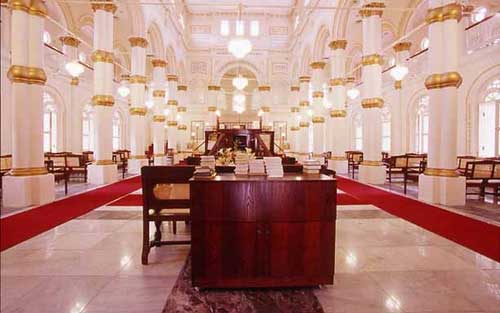
When I got there, everyone was saying 'Chag Sameach' and shaking hands. One of them was a Chabadnik, around my age. I forget his name, but he asked me 'where are you from?' and I said 'The USA' and he said 'yeah, of course, but where'.
There were guys my age from quite a variety of places; mostly France, Canada, and South Africa.
Someone asked me 'which Seder are you going to?' and I said 'I'm not sure'. There was one being held in the community center right next to the Synagogue, and one being held at someones house, about a 20 minutes walk away. I was told most of the young people were going to the house, so I went there.
Often, Jews remark how amazing it is that we have a culture that spans every continent, that has been remarkably preserved for 2000 years, even between communities that have very little contact with each other. I definitely felt that on the walk over to the house.
I had some interesting conversations on the walk there, which took a good deal longer than 20 minutes.
I had some pretty ineteresting conversations on the way over there. I talked to Ari, who was studying at Richard Ivey school of business in Canada, studying abroad at Singapore Management University. He told me about his adventures in Asia, including two weeks in Japan, and many other places; he even flew to Miami for two days for a wedding. He said that the quality of the students at SMU was pretty low; that they played around on Facebook all day, and called it studying, that they were rote learners who think inside the box, and things like that. He hadn't even gone to class for two weeks, that is how much he was able to get ahead. He noted that it is usually very easy for Westerners to advance in the financial industry in Singapore; "My friend who worked for Goldman Sachs would get to work every day at six in the morning before the markets would open, and stay till ten thirty at night, but these kids show up to work at nine, take a two hour lunch break at twelve, and go home at five... this is not true, though, for the people I know from Hong Kong, those guys are seriously efficient'.
I also talked to Hillary, a girl from Sioux City, Iowa. She had done some pretty extensive travelling in SE Asia, so I told her my (very rough) travel plans for what I was going to do after my last exam, on may 7. 'I am going to start in Cambodia, travelling with some French people. I will go up through Thailand, visiting Bangkok and Chiang Mai, and to Vientiane in Laos, and take the 24 hour bus ride to Hanoi, after which I will travel south to Ho Chi Minh city, and make my way back to Singapore for my flight home, if I can do that in a month'. I am not sure how plausible that is, in the time I will have. She remarked 'Are you sure they want to go to Laos? I hear that their government is anti-American, to which I responded 'yeah I wouldn't be surprised!'. She also expressed concern about Israeli-Lao relations. But a quick Google search reveals that her fears were completely overblown.
__________________________________________________________________________________________________________________________________________________________________
So, after a very hot and humid half-hour walk, and a five-minute, twice as hot and humid elevator ride, we arrive at the apartment. It was a nice place; there was a whole entire wall covered with family photos, in a very nice geometric arrangement. The seder plates had Sephardic haroset, made from dates. At first there were not enough chairs for everyone, so but when I finally sat down, I was right next to the head of the table, with the Seder leader, and his (I think) brother in law on my left, at the head. Across from me was a very elderly lady. To her right sat a couple guys from South Africa. To my right was Thomas, a Sephardic Jew from Paris, about my age, whose family's location before Paris was Libya. So the Seder went forward pretty normally; there were two differen Haggadot, the Ashkenazi Artscroll version, and a Sephardic version.
When we got to the part where we ate the Haroset, it was great, because that Sephardic date Haroset is seriously good; thick, sticky, black and super sweet; a bit like heroin.
At some point, Thomas told me that it can be difficult to be a Jew in France, because there is some anti Semitism, and some anti-Israel sentiment. During the time when we were enumerating the 10 plagues, I asked him 'hey, do you know if frogs are kosher?' and he said 'French people don't actually eat frogs, it is a myth'.
But the real interesting part of the night was talking to the elderly lady, who was the mom of the guy sitting on my right. It turns out that she was born in Baghdad, and emigrated to Singapore when she was six, in 1926. Back then, Singapore was just a small trading outpost, mostly Jungle. Her husband's family had even older roots in Singapore and Indonesia. Her son had also grown up in Singapore. At various points through the night, we had conversations about Singapore, such as our respective dislike and like of the fruit Durian. I also mentioned that I had visited the Synagogue in Yangon, Myanmar. He told me that the Synagogue there was build by Iraqi Jews.
The dinner was amazing. It included rice, because they were Sephardic. There was this amazing Iraqi fish puff, very nicely flavored. There were also amazing Iraqi chicken-potato dumplings, pickles, and chicken-rice similar to Biryani. The best thing, overall, though was some fried Okra; not in the American southern sense, but sliced very thin, and really crispy. A lot of this food was the recipe of the nice old lady, so I was eating Iraqi Jewish cuisine, something that I guess is, overall, pretty hard to find nowadays. No Matzoh ball soup, but still an amazing meal. I remarked 'I would choose this over gefilte fish any day!', and the guy said 'oh yeah I can't stand the stuff, how do you even eat it!'. I explained to him, though, that there is such thing as good Gelilte fish, you just have to get the fresh made kind.
So, overall, it was a good, interesting, meaningful Seder.
Thursday, March 13, 2014
Incident With Shoes
The very first night that I got here, I ate some Indian food with a guy named Thiru. I also bought some really great iced green jasmine tea made by a company called 'Heaven and Earth'. Today, I walked out of my room to go to the vending machine to get some of that tea. A girl, Cheryl commented 'oh, not wearing slippers'. To which I responded, 'oh yeah, I guess being barefoot outside is an American thing. And we usually call them shoes'. But just a second ago, I sent her this Facebook message: 'but the Sinaporean system of strictly no shoes inside, and always shoes outside definitely works better' ; Because it is totally true. The floors of all of the Singaporean dorm rooms are all cleaner than mine. Especially noticable on white table. Tsk tsk. Time to sweep.
Tuesday, March 11, 2014
Ate Breakfast this morning.
See, breakfast in my hall is pretty mediocre. It is just noodles or pasta, and by the time you are finished, you just think 'that was a little too much noodles'. But there is tea and coffee. I haven't had the coffee yet, but the tea is really good. Here, the tea is really strong, but not bitter. It has complex notes. For putting into it, we have sweetened condensed milk, sugar, and dried milk. I like the tea so much that I even had two cups this morning.
I must, furthermore, mention, that there is an interesting coffee/tea drinking lingo around here. If you go to a traditional coffee shop, you pronounce 'coffee' as 'kopi', and tea as 'teh'.
kopi/teh ping = iced coffee/tea
kopi/teh o = coffee /tea with sugar but no milk
kopi/ teh o kosong = coffee/tea with nothing at all
kopi teh c = coffee/tea with dried milk. 'c' as in 'carnation'.
'manis' means 'sweet'. There are words for 'more' or 'less' but at this moment I forget what they are.
Have a nice day!
I must, furthermore, mention, that there is an interesting coffee/tea drinking lingo around here. If you go to a traditional coffee shop, you pronounce 'coffee' as 'kopi', and tea as 'teh'.
kopi/teh ping = iced coffee/tea
kopi/teh o = coffee /tea with sugar but no milk
kopi/ teh o kosong = coffee/tea with nothing at all
kopi teh c = coffee/tea with dried milk. 'c' as in 'carnation'.
'manis' means 'sweet'. There are words for 'more' or 'less' but at this moment I forget what they are.
Have a nice day!
Wednesday, February 19, 2014
Going to Myanmar Tomorrow
Going to Myanmar tomorrow! Will be there until two Mondays from now. In spite of my best efforts, I will most likely will get food poisoning. Thats just how it works.
------------------------------------------------------------------------------------------------------
I know there are ethical issues about tourism in a country with a repressive government, Myanmar. Part of what I spend will help fund that government through taxes. The fact is, however, that the businesses that I will be spending money on really need it. My money will make a real difference in people's lives. So, in the end, I think that going to Myanmar is fine.
------------------------------------------------------------------------------------------------------
Continuing with the narrative:
I get in the Cab and I say 'can you take me to NUS?' and he says 'What, NUH? I said ' No NUS'.
'Oh great NUH is the hospital, much better to go to NUS than to the Hospital'.
We drive away. We start getting into the typical airport taxi type conversation. 'I will be here for five months or so'.
Certain details escape me.
I remember that he pointed to all of the lush greenery and said 'see all of this, everything here is nicely maintained and gardened'. And seriously, there were a lot of tropical plants on the median and sides.
Interestingly, this highway had traffic flowing on the right, and the car had the steering wheel on the right as well. For a bit, I was confused, but that highway turned out to just be an anomaly.
The taxi driver gives me the typical Singapore rules talk; 'This place is very safe, as long as you don't break any of the rules. If you do, you will be punished!'.
I ask him about gum. He says its a big no-no.
At some point we are driving through a HUGE, very long tunnel. He says 'see this? This was just opened last week!' the highway used to be above ground, and you could see all of downtown, but now there is just his tunnel. That's right. Singapore put a whole highway underground, without really needing to, they just thought it'd be nice.
When we get to NUS, I ask for directions to Temasek Hall, where I live, from a passerby. I was quite startled by his accent; Most Singaporeans at JHU have masked their accent pretty well, so that it sounds vaguely British. But a real Singaporean accent is very unique! I must mention that it is a true accent of the English language, just like a Scottish or Boston accent, as it is the language they speak here. In an Ultimate frisbee tournament I played in in the third week here, there was a team from Sheares Hall (another dorm). They were called the 'Shucks!', and the jerseys had a picture of a shark. I thought it was really clever of them to make fun of their own accent.
Interestingly, the people who I asked directions from were the second group of passersby who I saw. The first group the cab driver didn't reccomend I asked; he national-origin-ly (not racially) stereotyped them as being Chinese, and said that they might not know where Temasek was, and wouldn't know English very well. Having been here for some time, I think that this profiling is unwarranted; most Chinese people here have at the very least decent English. Now I know that, based on where they were walking, and the building complex they live in, they may very well have not know where Temasek Hall was, but the cab driver didn't have that information. It reminds me of a story one of my Singaporean-Chinese friends told me to day, so I will tell you later, because it is time to sign off.
------------------------------------------------------------------------------------------------------
I know there are ethical issues about tourism in a country with a repressive government, Myanmar. Part of what I spend will help fund that government through taxes. The fact is, however, that the businesses that I will be spending money on really need it. My money will make a real difference in people's lives. So, in the end, I think that going to Myanmar is fine.
------------------------------------------------------------------------------------------------------
Continuing with the narrative:
I get in the Cab and I say 'can you take me to NUS?' and he says 'What, NUH? I said ' No NUS'.
'Oh great NUH is the hospital, much better to go to NUS than to the Hospital'.
We drive away. We start getting into the typical airport taxi type conversation. 'I will be here for five months or so'.
Certain details escape me.
I remember that he pointed to all of the lush greenery and said 'see all of this, everything here is nicely maintained and gardened'. And seriously, there were a lot of tropical plants on the median and sides.
Interestingly, this highway had traffic flowing on the right, and the car had the steering wheel on the right as well. For a bit, I was confused, but that highway turned out to just be an anomaly.
The taxi driver gives me the typical Singapore rules talk; 'This place is very safe, as long as you don't break any of the rules. If you do, you will be punished!'.
I ask him about gum. He says its a big no-no.
At some point we are driving through a HUGE, very long tunnel. He says 'see this? This was just opened last week!' the highway used to be above ground, and you could see all of downtown, but now there is just his tunnel. That's right. Singapore put a whole highway underground, without really needing to, they just thought it'd be nice.
When we get to NUS, I ask for directions to Temasek Hall, where I live, from a passerby. I was quite startled by his accent; Most Singaporeans at JHU have masked their accent pretty well, so that it sounds vaguely British. But a real Singaporean accent is very unique! I must mention that it is a true accent of the English language, just like a Scottish or Boston accent, as it is the language they speak here. In an Ultimate frisbee tournament I played in in the third week here, there was a team from Sheares Hall (another dorm). They were called the 'Shucks!', and the jerseys had a picture of a shark. I thought it was really clever of them to make fun of their own accent.
Interestingly, the people who I asked directions from were the second group of passersby who I saw. The first group the cab driver didn't reccomend I asked; he national-origin-ly (not racially) stereotyped them as being Chinese, and said that they might not know where Temasek was, and wouldn't know English very well. Having been here for some time, I think that this profiling is unwarranted; most Chinese people here have at the very least decent English. Now I know that, based on where they were walking, and the building complex they live in, they may very well have not know where Temasek Hall was, but the cab driver didn't have that information. It reminds me of a story one of my Singaporean-Chinese friends told me to day, so I will tell you later, because it is time to sign off.
Thursday, February 13, 2014
So, all of you may have noticed that I have been somewhat negligent in updating this blog; I have not even gotten past writing about my 18 hour layover in Japan. One would hope that the reason behind this is that I have been doing more important things.
If that is true, then a secondary reason is perfectionism; a desire to make each post as long and detailed as my first. This leads to a psychology of 'oh I don't have time to do that much writing right now, so I will do it later'.
So, I am changing my strategy; perhaps by writing more short posts, as my dad's friend suggested, or by regular working on longer posts to post at periodic intervals.
I still have a desire for this blog to be a coherent narrative of my time in Singapore, so I will continue writing about events that happened a month and a half ago, and hopefully the past will catch up with the present.
Now, as I said, I sleep in the internet cafe in Tokyo; I catch the train back to the airport, collect my luggage, and get my boarding pass. I have a few hours in the airport; this is when the mishap with the sushi lady happens, mentioned in my first post. Without thinking, I also buy some gum (illegal in Singapore).
Without getting into any details, I will mention that the toilets in the airport had some pretty cool bells and whistles.
The plane ride over was really nice; Japan airlines is probably the best airline I have ever flown; the food actually seemed pretty fresh. There also several kinds of meat and fish included in the food. When I asked myself how many animals had died to feed me, I came up with the answer 'several'. Furthermore, hot green tea that they served was excellent.
So, I land in the SG airport, and nothing too eventful happens. At customs, they ask me about what I will be doing, in Singapore, and I explain that I will be studying. If I remember correctly, I showed them some documents I got from the school, and explain that I would be getting my actual student's pass (an ID card, I later found out) from the Immigration and Customs Authority at NUS the next week. They stamp my passport with a 'Social Visit Pass' good for 90 days. They also stamp my debarkation card with this pass; printed at the bottom of this card are the words "WARNING: DEATH TO DRUG TRAFFICKERS UNDER SINGAPORE LAW"**
I collect my baggage, and head for customs; I remember that I have some gum, so I go the 'items to declare' line. But they just wave me on through to the 'nothing to declare' line, and don't even check anything. I could have had anything! I neither confirm nor deny that I actually threw the gum away before going through customs. And I will neither confirm nor deny that I smuggled gum in from Malaysia this past weekend. And I will neither confirm nor deny that I am chewing gum as I write this post***.
So I catch a cab. The cab ride itself was interesting; I want to tell you about it, but I have reached the point where writing more would make this blog unsustainable to regularly update. You will hear about the cab ride, including and the conversation that I had with the driver, and my first sights of Singapore,at the beginning of the next post.
Tooteloo!
**They are serious. Since being here, I have learned that whether or not you are considered a trafficker is determined only by the amount of a substance that you possess. The initial sentencing is quickly carried out by a single judge, and there is one level of appeal, after which your only hope is presidential pardon. If (when) you are found guilty, you have a week, give or take to live.
As you might guess, Singapore does not have a drug problem.
***But, even though chewing gum is illegal Singapore, you just get a fine if caught, and I even hear that if customs agents catch you with it, you can just say 'its for personal use' and they will let you through. Some de-facto legalization.
Interestingly, if you read about the gum problems that Singapore was having a few decades ago, you would understand why it was outlawed. There was so much gum stuck on the subway doors that they would not open! You can read more about it here: http://en.wikipedia.org/wiki/Chewing_gum_ban_in_Singapore. I include an excerpt that I fount to be pretty hilarious below:
If that is true, then a secondary reason is perfectionism; a desire to make each post as long and detailed as my first. This leads to a psychology of 'oh I don't have time to do that much writing right now, so I will do it later'.
So, I am changing my strategy; perhaps by writing more short posts, as my dad's friend suggested, or by regular working on longer posts to post at periodic intervals.
I still have a desire for this blog to be a coherent narrative of my time in Singapore, so I will continue writing about events that happened a month and a half ago, and hopefully the past will catch up with the present.
Now, as I said, I sleep in the internet cafe in Tokyo; I catch the train back to the airport, collect my luggage, and get my boarding pass. I have a few hours in the airport; this is when the mishap with the sushi lady happens, mentioned in my first post. Without thinking, I also buy some gum (illegal in Singapore).
Without getting into any details, I will mention that the toilets in the airport had some pretty cool bells and whistles.
The plane ride over was really nice; Japan airlines is probably the best airline I have ever flown; the food actually seemed pretty fresh. There also several kinds of meat and fish included in the food. When I asked myself how many animals had died to feed me, I came up with the answer 'several'. Furthermore, hot green tea that they served was excellent.
So, I land in the SG airport, and nothing too eventful happens. At customs, they ask me about what I will be doing, in Singapore, and I explain that I will be studying. If I remember correctly, I showed them some documents I got from the school, and explain that I would be getting my actual student's pass (an ID card, I later found out) from the Immigration and Customs Authority at NUS the next week. They stamp my passport with a 'Social Visit Pass' good for 90 days. They also stamp my debarkation card with this pass; printed at the bottom of this card are the words "WARNING: DEATH TO DRUG TRAFFICKERS UNDER SINGAPORE LAW"**
I collect my baggage, and head for customs; I remember that I have some gum, so I go the 'items to declare' line. But they just wave me on through to the 'nothing to declare' line, and don't even check anything. I could have had anything! I neither confirm nor deny that I actually threw the gum away before going through customs. And I will neither confirm nor deny that I smuggled gum in from Malaysia this past weekend. And I will neither confirm nor deny that I am chewing gum as I write this post***.
So I catch a cab. The cab ride itself was interesting; I want to tell you about it, but I have reached the point where writing more would make this blog unsustainable to regularly update. You will hear about the cab ride, including and the conversation that I had with the driver, and my first sights of Singapore,at the beginning of the next post.
Tooteloo!
**They are serious. Since being here, I have learned that whether or not you are considered a trafficker is determined only by the amount of a substance that you possess. The initial sentencing is quickly carried out by a single judge, and there is one level of appeal, after which your only hope is presidential pardon. If (when) you are found guilty, you have a week, give or take to live.
As you might guess, Singapore does not have a drug problem.
***But, even though chewing gum is illegal Singapore, you just get a fine if caught, and I even hear that if customs agents catch you with it, you can just say 'its for personal use' and they will let you through. Some de-facto legalization.
Interestingly, if you read about the gum problems that Singapore was having a few decades ago, you would understand why it was outlawed. There was so much gum stuck on the subway doors that they would not open! You can read more about it here: http://en.wikipedia.org/wiki/Chewing_gum_ban_in_Singapore. I include an excerpt that I fount to be pretty hilarious below:
Revision of the Act[edit]

In 1999, United States President Bill Clinton and Singapore Prime Minister Goh Chok Tong agreed to initiate talks between the two countries for a bilateral free trade agreement (USS-FTA).[4] The talks later continued under the new administration of President George W. Bush. Details of the closed-door negotiations are unknown, but it became apparent that by the final phase of the negotiation in early 2003, there remained two unrelated issues: theWar in Iraq and chewing gum.
The Chicago-based Wm. Wrigley Jr. Company enlisted the help of a Washington, D.C lobbyist and of Illinois Congressman Phil Crane, then-chairmanof the United States House Ways and Means Subcommittee on Trade, to get chewing gum on the agenda of the United States-Singapore Free Trade Agreement.[5] This caused a dilemma for the Singapore Government. It recognised the health benefits of certain gums, such as a brand of sugar-free gum that contains calcium lactate to strengthen tooth enamel. Sale of this newly categorised medicinal gum was allowed, provided it was sold by a dentist or pharmacist, who must take down the names of buyers.
Soon, the USS-FTA was signed and the ban was revised. "They were tough," Crane said of the talks. Some found it surprising that Wrigley had fought hard on this battle, given the small size of Singapore's chewing market. But the company said it was worth it. "There's many examples in our history of things that may have not made short-term financial sense but was the right thing to do in a philosophical or long-term sense," said Christopher Perille, Wrigley's senior director of corporate communications.
Wednesday, January 29, 2014
Japan Part II
I will begin this post by tying down some loose ends from my last blog post, in which I described my 18 hour layover in Tokyo. At various points, I was unsure of whether or not the past tense of 'to drink' was 'drunk' or 'drank'. I indicated this by writing 'drank (drunk?)' as a way to indicate my uncertainty. Since then, I have determined that the past tense of 'to drink' is, indeed 'drank', and that 'drunk' is exclusively an adjective, describing the state of having drank (drunk?) too much alcohol.
So, I mentioned that I had been cheated out of $20. Here is how it happened; I went into a 7-11 (actually called just 7, remember) and I saw these little round breaddy things in little baggies (see picture) all connected. That is, the baggies were connected by perforations at their ends.

So, imagine like five or six of these things attached together by their serrated, perforated ends. So the logical thing to do is rip off the final one, and just buy that one. But instead, I rip off the last one, as well as a hole in the second to last one, and the little bready round things fall all over the floor. No problem, I pick them all up before anyone notices; maybe one guy just sees me pick up a single bready thing. So, when I go to pay, I indicate using sign language that I want to pay for two. Instead, the clerk walks over to where the things were, and says that I have to buy the whole strip. And he says (if I remember) that it is 2000 Yen! Which is like $20. But at that point, the two glasses of Sake were enough to make me oblivious, that I was being cheated, as well as to the fact that the Seven clerk was bringing DISHONOR to the whole of Japan through his perfidious actions. To any Japanese people who may be reading this, that was a joke.
I was at this 7-11 on the way from retracing the route from the internet cafe where I would sleep, to the train station. On the way, I see a pretty awesome street performer. In America, you sometimes see guys just playing solo Jazz trumpet or saxaphone, imrpovising, but never sounding any good. But this guy accompanied himself with DJ equipment that he controlled with his feet. He was jamming!
In this video, he was not quite on his game, but believe me, he could be when he wanted to.
I should also mention a small other story; when I got my second bowl of Ramen, they were playing the Beatles in the restaurant. When the song 'If I fell' came on, I sort of started singing it aloud, and really in tune. This group of Japanese girls could hear me; hopefully they realized 'people actually know these English songs'.
Finally, the internet cafe was interesting, in and of itself. Apparently Japenese people sleep here when they have been out clubbing later than the last subway train. There was a whole machine full of interesting Japanese complimentary soft drinks! But by that point I had come to accept that every country that I visit will have way too many interesting new soft drinks than I can try without catching the beetus. There was also an extensive library of Japanese comics for people to read. And a shower, but it was locked, and I could have asked for the key, but I was tired, and didn't feel like going through the logistics of being wet.
The place where I slept was a small square, where I couldn't quite extend myself, even if I lay along the hypotenuse.
A final interesting thing about Japan is that they have designated smoking zones in the middle of the sidewalk.
 I am not sure if this is the only place where you are allowed to smoke, or what. Anyway, at these places I could always ask for directions, because I had a captive audience. With regards to American politics, I am not sure of where I stand with regards to the government restricting smoking in private restaurants; on one hand it infringes on the rights of bar owners to set the rules for what happens on the premises of their own businesses, while on the other, I really hate cigarettes. Japan, however, seems to have taken it a step further. Upon further consideration, the government does have an undeniable right to control what may be seen as a public nuisance (ie smoking in the streets). But the effect was to create areas where there was a really unpleasant haze, whereas without the restriction, the cigarette smoke would have been diluted.
I will conclude my discussion of my time in Japan by mentioning that I did, in fact, see a certain amount of Japan's sleazy side. Twice (on the same block) I was harassed by women of loose morals on the street, and was forced to politely jog away.
Even though there is almost no litter on the streets of Japan, I did, in fact, see quite a few men spitting on the sidewalk.
At one point I saw a rat in an alley.
The most sleazy example by far, though, was a strange establishment that I saw in some shady alley. I would frequently walk down dark alleys, in search of interesting places like that small bar I mentioned in my last post. (Keep in mind that there is almost no violent crime in Japan. I would use better judgment in a city like London, for example). Many times I did, in fact see interesting small restaurants. But once, I saw a guy just sort of sitting at a desk in an open storefront. I approached him, and tried to ask just what kind of business he was running there. I tried offering small sums of money for maybe a small whatever product he was selling (specialty fish products maybe?); but he reacted with scared, angry indignation. So, at that point I realize that this guy was running some kind of shifty operation. At that point I do some make shift sign language, to him, demonstrating non-standard ways of taking in substances (I was just trying to figure out what the deal was!). He kept on reacting with the same shifty attitude. I then hold up my iphone, non-verbally asking permission to take a photograph. He REALLY wasn't happy about that. Then I notice an easel with pictures of scantily clad women, and I high tail it out of there.
So, overall Japan was pretty cool, I guess.
I have been in Singapore for about a month now. In that time, I have met amazing people from all over the world, tried amazing food, and even traveled to Hong Kong for a weekend. But just like every successful installment in a series of masterpieces, this blog post is ending with a cliffhanger. Until next time!
So, I mentioned that I had been cheated out of $20. Here is how it happened; I went into a 7-11 (actually called just 7, remember) and I saw these little round breaddy things in little baggies (see picture) all connected. That is, the baggies were connected by perforations at their ends.
So, imagine like five or six of these things attached together by their serrated, perforated ends. So the logical thing to do is rip off the final one, and just buy that one. But instead, I rip off the last one, as well as a hole in the second to last one, and the little bready round things fall all over the floor. No problem, I pick them all up before anyone notices; maybe one guy just sees me pick up a single bready thing. So, when I go to pay, I indicate using sign language that I want to pay for two. Instead, the clerk walks over to where the things were, and says that I have to buy the whole strip. And he says (if I remember) that it is 2000 Yen! Which is like $20. But at that point, the two glasses of Sake were enough to make me oblivious, that I was being cheated, as well as to the fact that the Seven clerk was bringing DISHONOR to the whole of Japan through his perfidious actions. To any Japanese people who may be reading this, that was a joke.
I was at this 7-11 on the way from retracing the route from the internet cafe where I would sleep, to the train station. On the way, I see a pretty awesome street performer. In America, you sometimes see guys just playing solo Jazz trumpet or saxaphone, imrpovising, but never sounding any good. But this guy accompanied himself with DJ equipment that he controlled with his feet. He was jamming!
I should also mention a small other story; when I got my second bowl of Ramen, they were playing the Beatles in the restaurant. When the song 'If I fell' came on, I sort of started singing it aloud, and really in tune. This group of Japanese girls could hear me; hopefully they realized 'people actually know these English songs'.
Finally, the internet cafe was interesting, in and of itself. Apparently Japenese people sleep here when they have been out clubbing later than the last subway train. There was a whole machine full of interesting Japanese complimentary soft drinks! But by that point I had come to accept that every country that I visit will have way too many interesting new soft drinks than I can try without catching the beetus. There was also an extensive library of Japanese comics for people to read. And a shower, but it was locked, and I could have asked for the key, but I was tired, and didn't feel like going through the logistics of being wet.
The place where I slept was a small square, where I couldn't quite extend myself, even if I lay along the hypotenuse.
A final interesting thing about Japan is that they have designated smoking zones in the middle of the sidewalk.
I will conclude my discussion of my time in Japan by mentioning that I did, in fact, see a certain amount of Japan's sleazy side. Twice (on the same block) I was harassed by women of loose morals on the street, and was forced to politely jog away.
Even though there is almost no litter on the streets of Japan, I did, in fact, see quite a few men spitting on the sidewalk.
At one point I saw a rat in an alley.
The most sleazy example by far, though, was a strange establishment that I saw in some shady alley. I would frequently walk down dark alleys, in search of interesting places like that small bar I mentioned in my last post. (Keep in mind that there is almost no violent crime in Japan. I would use better judgment in a city like London, for example). Many times I did, in fact see interesting small restaurants. But once, I saw a guy just sort of sitting at a desk in an open storefront. I approached him, and tried to ask just what kind of business he was running there. I tried offering small sums of money for maybe a small whatever product he was selling (specialty fish products maybe?); but he reacted with scared, angry indignation. So, at that point I realize that this guy was running some kind of shifty operation. At that point I do some make shift sign language, to him, demonstrating non-standard ways of taking in substances (I was just trying to figure out what the deal was!). He kept on reacting with the same shifty attitude. I then hold up my iphone, non-verbally asking permission to take a photograph. He REALLY wasn't happy about that. Then I notice an easel with pictures of scantily clad women, and I high tail it out of there.
So, overall Japan was pretty cool, I guess.
I have been in Singapore for about a month now. In that time, I have met amazing people from all over the world, tried amazing food, and even traveled to Hong Kong for a weekend. But just like every successful installment in a series of masterpieces, this blog post is ending with a cliffhanger. Until next time!
Tuesday, January 14, 2014
Off
It has been 48 hours or something since I left home and it has been a wild ride. I got up pretty early on Saturday to head to the airport. My dad made a pretty baller breakfast to send me off.
So.
The flight to Chicago went smoothly. Landed in Chicago with an hour or so to spare before the flight to Narita airport in Japan. Not unexpectedly, there were a lot of Japanese people at the gate.
Now, for the past few days or so, I had been having an internal/external debate of whether it would be better to spend my 18 hour layover in the relatively quiet Airport town of Narita, or take the train into Tokyo. All through the flight to Chicago I was having a pretty heated internal dialogue, comparing the the pros and cons of each option.
"You have a plane to catch, if you get lost in Tokyo and miss your plane you will regret it big time"
"But you might regret it even more if you knew that you had the chance to go to TOKYO and spent the night chatting with other westerners in a backpacker's hostel"
" you don't even know where to stay in Tokyo, what are you gonna do, sleep on the streets? Pay $100 for a hotel?'
"Whatever Jordan, whatever."
Keep in mind that I had already cancelled my reservations at the Narita hostel, as a preemptive preparation for going to Tokyo.
So, at the gate I asked some Japanese people for advice, and the ones that spoke English unanimously said that I should go to Tokyo.
So, I got on the plane, in my seat that was at the center of the five seat center line of seats that typically exists on these international flights. The guy on the left of me (Japanese guy who could speak English) asked to change seats, so that he could be with his friends, so I was sitting in the second seat on the left. Throughout the flight we had many interesting conversations; he is a graphic designer; I forget if he lives in Tokyo, or somewhere else, but a major theme of the conversation was whether it would be better to go to Narita or Tokyo. He said Tokyo. I mentioned the temple in Narita, and he said that it would be closed by the time I got there. He also said that, for Ramen, which I wanted to eat, Tokyo would be better.
I asked about navigating the train system. He pointed me to his friend sitting two seats down, named Kyoko, who would be heading home on the train in the direction of Shibuya, the Times-Square like neighborhood of Tokyo. I could follow her, and she could help me change trains.
What about where to stay? He directed me to one of two hotels, one called 'NetCafe', the other called 'Manga', as in Japanese comics. He furthermore told me that rooms there were cheap, and that I could pay prices like 4000 Yen (~$4) an hour to stay there, and that I could get a shower as well.
Interesting. I decided that it would give Tokyo a try.
He said that people know about these places, and that if I went to Shibuya, I should have no problems finding them. He even told me how to say 'where is ___?' in Japanese, and I wrote it in a note on my cellphone.
I had a lot of conversations about Japan, and what we both did for a living /in anticipation of making a living, with that guy, but slowly something seemed very wrong.
From the beginning, I noticed that he had a very effeminate manner, and that was ok, because it made sense in light of the fact that he was a graphic designer (I guess I am being honest about certain stereotype that I have). When he told me that his name was Yoko, as in Yoko Ono, I didn't blink. I just assumed that Yoko could be a girls or guys name.
But sure enough, when we were walking off the plane twelve hours later, I could say with a high level of certainly that who I was talking to was not the guy in his late twenties, who I thought, but instead a just-past middle aged woman. I guess it was the haircut that threw me off. A low voice as well, and the Japanese accent.
Anyway.
The concourse to the terminal was really busy; just a big river of Japanese people. You couldn't stand still, because you would be in the way. I walked with Kyoko, who was without a doubt a woman in her early to mid thirties. She said that she was from Kyoto, a city, which she informed me, has many old temples, and that in fact the Kanji symbol for Kyoko and Kyoto are the same. She is a nursing teacher.
She didn't speak too much English, though, so I couldn't ask too much. When she told me that she was a nursing teacher, I said 'oh, so you are a professor!'. But I don't think that she understood that.
So, at the end of the concourse, I went through immigration. I definitely had the sensation of being taller than everyone else.
By the time I got to the baggage claim, Kyoko had caught her train, which was fine, as I had told Yoko to tell Kyoko that she should not miss her train just to shepherd me around.
I was able to store my bags at the airport, and get a round trip train ticket (to Tokyo) with help from the information counter. Contrary to what Yoko had told me, I could get a train directly to Shibuya from the airport.
I was really thirsty, so I decided to get a drink from a vending machine on the platform. I bought a milk tea, a drink that my sister and mom had drunk (drank?) in Hawaii. Really milky and sweet. A potion of fat and sugar. To my surprise it came out hot! The moral of the paragraph: Japanese vending machines are capable of dispensing of hot beverages. Remember that the next time you find yourself in Tokyo.
I was still thirsty so I got what I thought was a green tea. Instead, it was a drink (cold as expected) that tasted like a mixture of bad weak coffee and water flavored with sticks and leaves, like you might see in a puddle on a hiking trail. I didn't actually didn't finish it that night, and had to chug it in the airport security line the next day.
So.
I was quite impressed by the train when it arrived. It was seriously shiny and sleek; like something out of those 80s Tron movies, or something.
You have to get onto the correct car, because they split off en-route to head to different places in Japan. A major example of how advanced and integrated the country is. The train smoothly came to a stop with the doors at locations exactly as indicated by the signs on the platforms.
You have to get onto the correct car, because they split off en-route to head to different places in Japan. A major example of how advanced and integrated the country is. The train smoothly came to a stop with the doors at locations exactly as indicated by the signs on the platforms.
The train ride to Shibuya was pretty uneventful. It was pretty dark, so I could not see too much. I guess that that in itself says something about Japan: relatively poor lighting in the countryside or something. Somehow, or other, though I struck up a conversation with a guy who had been sitting near me (once again getting lucky with someone speaking English). His name was Tomo, and as of this moment I forget what he does for a living. Anyway, we just started talking, and I mentioned that I wanted Ramen, and he said that he would show me his favorite Ramen place in Shibuya. It was also lucky that I met him because it was slightly complicated to walk out of Shibuya station. Anyway, the view out of Shibuya station is pretty dazzling. Yes, there are bright signs like in Times square, but what is even more amazing is known as 'the scramble'. It is basically a huge intersection of a few busy streets and sidewalks, where, when it is time to cross, they stop traffic in all directions, so that pedestrians can cross from corner to corner as well as from side to side. What results is an amazing sea of people. Tomo took pictures of me right there (soon to be posted), and you can tell from my face that I was pretty amazed.

So, we walk through the streets of Shibuya, going to this Ramen place. They are narrow, streets exclusively for pedestrians, and there are restaurants and stores everywhere that all look pretty amazing. He kept on saying 'This Ramen place is really good too'. Evidence of the high Ramen quality in Japan. Japan is, afterall, where Ramen comes from.
When we get to the place, it is a very crowed soup counter extending around a kitchen where you can see them making the soup. Interestingly, the soup chefs were all wearing rain boots, and would dump hot noodle water onto the ground from time to time. There was an interesting ordering system; you selected your meal and paid at a vending machine outside the restaurant, got a ticket, and handed it to the staff inside. Tomo asked me what I wanted, and I told him to pick what he would get if he was super hungry.
It was a big bowl of soup with many pieces of sliced pork belly. Really good. There was this kimchi-like scallion garnish on the counter that was really good in the soup, too.

Tomo left me when I got my soup, and confirmed that the mysterious hotel that Yoko had mentioned on the plane was a place that I could stay. He also gave me a CD of music that he composed; it is pretty good; a mixture of electronic beats, violin and piano, listening to it this moment as i write. It has his email address, so I will certainly contact him soon and thank him for helping me.
So, afterwards I just start wandering the streets of Shibuya, with no particular goal in mind. I occasionally ask about this 'NetCafe' place, and people occasionally point me in a direction, but I always see something interesting and veer off.
So, I just have, in general, a good time seeing everything. This is where my memory gets a teeny bit foggy about what specifically I did that night. Not that I was tipsy or anything, that comes later. I was just sort of wandering around, not doing anything in particular, because everything was interesting. Even convenience stores are interesting in foreign countries. What I talk about from now on will be heavily decided by what I took photos of. Here is a picture of another milk tea that I got in a 7-11. They are simply called 'Seven' in Japan. I can see why, as it would be cruel to the Japanese and damaging to the brand to have a store name that requires differentiation between the 'L' and 'R' sound. It is meaningful to me, because I had drank (drunk?) that brand of milk tea in China, it tasted really good, so I had been looking forward to another bottle for a few years. Note Donald Duck on the bottle.

I took a walk through one of the ubiquitous slot machine Casinos in this neighborhood, with childishly bright lights and fast paced musack, like you might expect in a Chuck-E-Cheese. For anyone who was a child in the nineties, except for my cousins the Levines, this description will bring up images of a certain casino in Celadon city acting as a front for a criminal organization, headquartered in the basement.

All of the restaurants look amazing; very small places, tucked away into basements. It was fun just looking at them. What is more, the people inside were all Japanese, not tourists. My parents mentioned a tiny soup place in NYC that they were shown by my cousins. Mom, Dad, picture every restaurant being like that.
I even see a really clean looking Sushi place, like the kind that Jiro has. I didn't go in. I didn't even have any sushi in Japan, except for in the airport the next day, and that sushi was even better than any American sushi that I had had. I actually had a small confrontation with them; somehow they thought that I had ordered twice the sushi I really asked for. When they brought it out, I motioned that I did not want it. They called me a gaijin. Sryslay, I don't begrudge them for not speaking English, but don't call your customers derogatory names when there is a miscommunication in an international airport. But I digress.
At some point I find an internet cafe. A huge one that takes up a ten story building. Open 24-7. And I realize; I am supposed to sleep in the internet cafe. I guess it shows my expectation that the Japanese would give something a weird name. Hotel NetCafe? Seriously? I walk back to the train station, but get lost. Drats.
As I am walking around, looking for this place, I see these rows of rather small buildings, in contrast with the surrounding skyscrapers. I take a duck down the Alley, and find a bar that is literally smaller than the single dorm room that I am writing from in Singapore.
 Before going in, I point to the bar, and ask to a passerby 'Gaijin?' (the Japanese word for Gringo), to see if it was OK for Westerners to go in there. I guess I was intimidated by how traditionally Japanese these buildings seemed. He pointed at the building and said 'Enjoy'. I asked for a Sake. This was the first time that I had ever had that beverage. It was quite good; really tasted as I would expect rice wine to taste. It is very interesting to me that they make a wine from a grain. Why can't we westerners make wine from, say, wheat? It tasted distinctly like wine, definitely not like beer or hard alcohol. Very smooth and refreshing. In the course of charging my iPhone, and chatting with the bar tender, I got directions to an internet cafe. The bar-tender informs me that these old buildings are from the 1950s
; a true relic among the modern buildings.
He points me to a different internet cafe. On the way there, I get some more Ramen. And get cheated out of $20 (2000 Yen). I want to say more, and explain, but it has been a week in Singapore already, and this post is long enough. I will update it later. Classes have started, and it is time to put my nose to the grindstone.
At some point I see a video of a Japanese boy band that seems like it is straight out of the 90s (above).
Again, I just want to get this post out there, I will fill in the details later.

So, we walk through the streets of Shibuya, going to this Ramen place. They are narrow, streets exclusively for pedestrians, and there are restaurants and stores everywhere that all look pretty amazing. He kept on saying 'This Ramen place is really good too'. Evidence of the high Ramen quality in Japan. Japan is, afterall, where Ramen comes from.
When we get to the place, it is a very crowed soup counter extending around a kitchen where you can see them making the soup. Interestingly, the soup chefs were all wearing rain boots, and would dump hot noodle water onto the ground from time to time. There was an interesting ordering system; you selected your meal and paid at a vending machine outside the restaurant, got a ticket, and handed it to the staff inside. Tomo asked me what I wanted, and I told him to pick what he would get if he was super hungry.
It was a big bowl of soup with many pieces of sliced pork belly. Really good. There was this kimchi-like scallion garnish on the counter that was really good in the soup, too.

Tomo left me when I got my soup, and confirmed that the mysterious hotel that Yoko had mentioned on the plane was a place that I could stay. He also gave me a CD of music that he composed; it is pretty good; a mixture of electronic beats, violin and piano, listening to it this moment as i write. It has his email address, so I will certainly contact him soon and thank him for helping me.
So, afterwards I just start wandering the streets of Shibuya, with no particular goal in mind. I occasionally ask about this 'NetCafe' place, and people occasionally point me in a direction, but I always see something interesting and veer off.
So, I just have, in general, a good time seeing everything. This is where my memory gets a teeny bit foggy about what specifically I did that night. Not that I was tipsy or anything, that comes later. I was just sort of wandering around, not doing anything in particular, because everything was interesting. Even convenience stores are interesting in foreign countries. What I talk about from now on will be heavily decided by what I took photos of. Here is a picture of another milk tea that I got in a 7-11. They are simply called 'Seven' in Japan. I can see why, as it would be cruel to the Japanese and damaging to the brand to have a store name that requires differentiation between the 'L' and 'R' sound. It is meaningful to me, because I had drank (drunk?) that brand of milk tea in China, it tasted really good, so I had been looking forward to another bottle for a few years. Note Donald Duck on the bottle.

I took a walk through one of the ubiquitous slot machine Casinos in this neighborhood, with childishly bright lights and fast paced musack, like you might expect in a Chuck-E-Cheese. For anyone who was a child in the nineties, except for my cousins the Levines, this description will bring up images of a certain casino in Celadon city acting as a front for a criminal organization, headquartered in the basement.

All of the restaurants look amazing; very small places, tucked away into basements. It was fun just looking at them. What is more, the people inside were all Japanese, not tourists. My parents mentioned a tiny soup place in NYC that they were shown by my cousins. Mom, Dad, picture every restaurant being like that.
I even see a really clean looking Sushi place, like the kind that Jiro has. I didn't go in. I didn't even have any sushi in Japan, except for in the airport the next day, and that sushi was even better than any American sushi that I had had. I actually had a small confrontation with them; somehow they thought that I had ordered twice the sushi I really asked for. When they brought it out, I motioned that I did not want it. They called me a gaijin. Sryslay, I don't begrudge them for not speaking English, but don't call your customers derogatory names when there is a miscommunication in an international airport. But I digress.
At some point I find an internet cafe. A huge one that takes up a ten story building. Open 24-7. And I realize; I am supposed to sleep in the internet cafe. I guess it shows my expectation that the Japanese would give something a weird name. Hotel NetCafe? Seriously? I walk back to the train station, but get lost. Drats.
As I am walking around, looking for this place, I see these rows of rather small buildings, in contrast with the surrounding skyscrapers. I take a duck down the Alley, and find a bar that is literally smaller than the single dorm room that I am writing from in Singapore.

; a true relic among the modern buildings.
He points me to a different internet cafe. On the way there, I get some more Ramen. And get cheated out of $20 (2000 Yen). I want to say more, and explain, but it has been a week in Singapore already, and this post is long enough. I will update it later. Classes have started, and it is time to put my nose to the grindstone.
Again, I just want to get this post out there, I will fill in the details later.
Subscribe to:
Posts (Atom)